
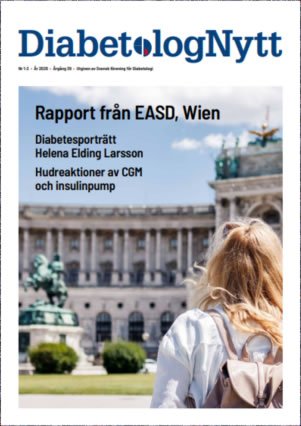
Dagens Medicin www idag
Sessionen om ATG, antitymocytglobulin och verapimil, verkar bevara betcellernas funktion under steg 3 T1DM,
väckte entusiasm under EASD, en av kongressens höjdpunkter, enligt Jarl Hellman i intercvju på www
Minimum effective low dose of antithymocyte globulin in people aged 5–25 years with recent-onset stage 3 type 1 diabetes (MELD-ATG): a phase 2, multicentre, double-blind, randomised, placebo-controlled, adaptive dose-ranging trial
Summary
Background
Methods
Findings
Interpretation
EASD Urges Population Screening for Early Type 1 Diabetes
Vienna — A panel of experts from the European Association for the Study of Diabetes (EASD) has recommended
general population screening for early-stage type 1 diabetes (T1D) beginning at age 2-4 years.
Only about 15% of children who develop T1D have a first-degree family member with the condition,
making universal screening necessary for early identification of the majority of affected individuals,
explained panel member Anette-Gabriele Ziegler, MD, director of the Institute of Diabetes Research, Helmholtz, Munich.
An autoimmune condition, T1D is now known to develop in three stages.
In stage 1, the person has two or more islet autoantibodies (IAbs) but blood sugar is still normal.
In stage 2, there is autoimmunity and dysglycemia but no symptoms.
Stage 3 is the clinical diagnosis of overt T1D, with autoimmunity and pronounced hyperglycemia until insulin treatment is given.
Children in stage 1 have about a 44% likelihood of progressing to stage 3 T1D within 5 years, and those in stage 2 have a 75% chance.
Screening Recommendations
The EASD panel recommends that — where policy and infrastructure are in place — IAb screening using commercially available IAb assays should be offered to the general population. Screening should begin with children aged 2-4 years, and if IAb is negative, it should be repeated at 6-8 years and at 10-15 years. Less is known about progression to T1D in the population older than 15 years, although teenagers may be screened if they haven’t been previously. Repeat tests are recommended for those who screen positive.
Prior to starting such a screening program, the panel recommends, “there must be developed infrastructure for
1) confirmation of positive results, and
2) monitoring for those with early stage T1D, including referral pathways between primary and secondary care, and between pediatric and adult services, as needed.”
A draft of the new recommendations was presented here at the EASD 2025 Annual Meeting by several of the writing panel members. The document will be submitted for peer review and publication. Other relevant medical organizations are also reviewing it for possible endorsement.
A similar process was used for a previous consensus statement from some of the same panel members regarding management of people who screen positive, panel chair Anastasia Albanese-O’Neill, PhD, APRN, CDCES, director of community screening and clinical trials education at Breakthrough T1D, told Medscape Medical News.
Population T1D screening programs are already in place in Germany, Italy, Israel, the UK, and elsewhere, including some regions of the United States such as Colorado. Screening of first-degree relatives of patients with T1D has long been available through the international network TrialNet.
While targeted screening of people at increased risk due to personal or family history of autoimmune disease may be a practical starting point, the ultimate goal is general population screening, said Ziegler.
Panel member Marian Rewers, MD, PhD, professor of pediatrics at the University of Colorado and executive director of the Barbara Davis Center for Diabetes Pediatric Clinic, Aurora, said that the expected benefits of population screening for T1D include the enabling of metabolic monitoring to avoid the development of diabetic ketoacidosis at the time of stage 3 onset; the opportunity to receive disease-modifying therapy such as teplizumab, with more options expected soon; and the opportunity to participate in clinical trials of novel interventions to stop or slow progression to insulin dependence.
Possible harms — such as increased anxiety, false positive results or false reassurance following a negative screen, and stigma from an early-stage diagnosis — can all be mitigated, said Rewers.
Cost and Infrastructure Concerns
Timothy J. Lyons, MD, professor of medicine at the Medical University of South Carolina, Charleston, and executive medical director of Diabetes Free South Carolina, said that cost would likely be a problem, at least in the United States.
“[If] you’re going to screen the entire population, that’s a lot of people,” he said. In the United States, where a lot of money is spent on healthcare, “we don’t do a good job of preventive healthcare. This would be preventive healthcare. We need to spend more money on that and less money on expensive end-stage disease.”
“If you get a positive test, you have to confirm it,” Lyons noted, and this would require “a lot of time and manpower, interpreting it correctly, and communicating it back to the patients.”
While it may work well in systems with universal healthcare and structured care for children, “we have very few ways to deliver population-wide healthcare in the US,” he added. “We have fragmented healthcare systems and competing agencies. It would have to be paid for by Medicaid, and right now that’s challenging.”
Rewers recently published a review paper on the cost of T1D screening. He noted that some analyses found cost-effectiveness for early T1D screening due to the health benefits, particularly reduction in diabetic ketoacidosis incidence, and that future availability of more disease-modifying drugs may improve the outlook. Nonetheless, real-world results may differ by state and healthcare systems, as well as other factors.
The EASD guidance advises that IAb testing be embedded into established public health activities such as vaccination clinics and well-child clinic appointments, said panel member and EASD President Chantal Mathieu.
“It is expected that different healthcare services will adopt the screening context that is most appropriate to their regional public health goals,” she said, adding that “IAb screening should promote equity of access for all individuals, independent of socioeconomic status, ethnicity, or regional location.”
Mathieu also said that where this screening is offered, providers should be knowledgeable about the process including the effective communication of results and any necessary referrals, and “it is expected that adequate reimbursement for these activities is available.”
From www.medscape.com
_____________________________
From www.diatribe.org
Key takeaways:
- With the rising incidence of type 1 diabetes, better screening is needed to identify who will develop the condition.
- It’s possible to identify presymptomatic type 1 diabetes through antibody testing. There are also several drugs being developed to delay the onset of type 1 diabetes.
- A number of type 1 diabetes research programs worldwide have helped extend screening pilots, with some countries already implementing nationwide pediatric screening.
While type 1 diabetes is often thought of as a genetic condition that runs in certain families, the reality is that at least 85% of people who are newly diagnosed do not have a family history of diabetes.
A considerable proportion of these people find out they have diabetes through diabetic ketoacidosis (DKA), a condition of severe high blood sugar that can lead to coma or death if untreated.
With the rising incidence of type 1 diabetes, especially among youth and teens, better screening is needed to identify who will develop the condition. Early identification allows for proactive treatment and management, which reduces the risk of complications like DKA and heart, kidney, and eye disease.
Experts like Dr. Emily Sims, a pediatric endocrinologist at Riley Hospital for Children in Indiana, argue in favor of general population screening for type 1 diabetes. Sims cited the ability to effectively identify presymptomatic type 1 diabetes and delay the onset of diabetes using medications like Tzield (teplizumab) as key reasons for universal screening.
For Robin Arzón, vice president of fitness programming and head instructor at Peloton who lives with type 1 diabetes, screening is a key part of self-advocacy.
“As someone living with type 1 diabetes, I believe that knowledge is power,” Arzón said. “I want folks to feel empowered when they’re navigating these conversations around type 1 diabetes screening.”
• Testing for antibodies can identify type 1 diabetes
To implement population screening, there must be a reliable method to identify people at risk of developing type 1 diabetes.
Sims said that researchers and health care providers can identify presymptomatic type 1 diabetes in family members and the general population through antibodies. A large body of evidence shows that people with two or more islet autoantibodies (antibodies to the islet cells that produce insulin) have nearly a 100% chance of developing type 1 diabetes in their lifetime.
Testing for autoantibodies can be completed at home through the TrialNet clinical trial program, or at a doctor’s office or lab. For instance, JDRF’s T1Detect program provides at-home testing for $55, with lower-cost options for people in financial need.
Reviewing the stages of type 1 diabetes, Sims emphasized that the process of developing the condition takes place over years. As a result, there is ample time to intervene in the early stages.
- Stage 1: At the beginning, people have at least two islet autoantibodies with normal blood sugar. Children who reach stage 1 have a 44% and 70% chance of developing diabetes in the next five and 10 years, respectively.
- Stage 2: This is when people begin to show signs of abnormal blood sugar. There is a 75% risk of progressing to type 1 diabetes in the next five years in stage 2.
- Stage 3: During stage 3, people are diagnosed with clinical type 1 diabetes and begin insulin treatment.
• Early screening prevents complications and provides a safe landing for diagnosis
Sims discussed the potential to reduce rates of DKA at the onset of type 1 diabetes as a major reason for population screening.
DKA not only results in considerable costs for patients and the healthcare system, but it also has long-term consequences for brain function and glucose management. Research shows that early screening and diabetes education lead to dramatic reductions in DKA rates.
That is, when caregivers know the signs of DKA, they can watch out for symptoms and seek medical attention right away. For instance, children in the TEDDY study who underwent screening had a DKA rate of 13%, compared to an expected rate of 24-55% without screening. Overall, Sims said education and monitoring reduce DKA from an expected rate of 25-50% to about 3-15%.
Beyond lowering the risk for DKA, identifying and monitoring people with presymptomatic type 1 diabetes allows for early education regarding all aspects of diabetes care.
Healthcare providers can slowly introduce different parts of diabetes management, rather than overloading a newly diagnosed patient with information all at once. For instance, it may be helpful to start with the concept of carb counting, followed by glucose monitoring, and then insulin treatment.
In this way, Sims said early identification allows for a “safe landing” and smooth progression into the diagnosis of clinical type 1 diabetes. Screening gives people time to consider questions, preferences, and goals for their eventual diagnosis.
“I’m grateful that my mom urged me to go to the doctor when I was experiencing symptoms, and the diagnosis didn’t come in a moment of crisis,” Arzón said.
“The more lead time – whether it’s a day, a week, a month or a year – the more you’re going to be able to plan and educate yourself and see what’s right for yourself and your family and find the right doctors,” Arzón said. “Education creates agency, and in a moment of crisis, sometimes we feel like we’re robbed of that.”
• Changing the course of type 1 diabetes
Tzield made history in November 2022, becoming the first FDA-approved medication to delay the onset of type 1 diabetes.
While the main clinical trial found that teplizumab delayed diabetes by an average of two years, follow-up data showed that the drug can delay type 1 diabetes by up to five years. Five years is a big difference – that could mean postponing a diagnosis of diabetes from kindergarten to fourth grade, or from ninth grade to college.
Prior to Tzield’s approval, the motivation to screen for type 1 diabetes was limited, since health care providers couldn’t offer any treatments to change the course of the condition. With the approval of Tzield, the conversation has changed. People who know they have two or more autoantibodies now have an option to halt the development of diabetes.
Indeed, the 2025 American Diabetes Association (ADA) Standards of Care recommend more intensive monitoring for the progression of preclinical type 1 diabetes. The Standards of Care also recommend using Tzield to delay the onset of diabetes in people at least 8 years old with stage 2 type 1 diabetes.
Looking ahead, there are several other drugs in development to delay or reverse type 1 diabetes:
- Verapamil: This low-cost blood pressure drug has been shown to preserve insulin-producing cells in youth recently diagnosed with type 1 diabetes.
- BMF-219: Known as an oral menin inhibitor, this drug is being explored for type 1 diabetes after yielding promising A1C reductions in participants with type 2 diabetes.
- VX-880: A stem-cell derived beta cell therapy, VX-880 led to significant improvements in A1C and time in range, in addition to reducing insulin needs in small studies of people with type 1 diabetes.
• Advantages and disadvantages of general population screening
As research on screening for type 1 diabetes continues to evolve, different strategies have been proposed for population screening:
- Genetic screening could help identify people at the highest risk and may lead to cost savings by screening fewer people overall. However, genetic screening involves a conversation to explain genetic risk and follow-up appointments to re-screen throughout one’s life.
- Autoantibody screening for the general population allows for screening and diagnosis at the same time. However, researchers haven’t determined optimal ages for screening that are early and frequent enough to reduce DKA while still being feasible for the healthcare system.
In a recent 2025 study based in the U.K., nearly 25,000 children between ages 3-13 were screened for type 1 using a simple fingerstick test that can be performed at home or school. The samples were then sent out to a lab for autoantibody testing. Of the 160 children who screened positive, 73% were in stage 1 – the earliest stage – of type 1 diabetes, before insulin use is required. Researchers also reported that 85% of families completed the education and follow-up after screening, and 98% said the screening experience was beneficial and would recommend it to others.
The future also holds promise for large-scale early detection programs. A number of research programs and screening pilots for type 1 across the globe, such as those detailed in the video below, have led to countries such as Italy implementing nationwide pediatric autoantibody screening for type 1 diabetes, as well as collaborations between countries to optimize and extend screening programs across the world.
Sims noted that either approach could work.
“What we need to do is start a lot of programs and scale them to understand how they’re working in different environments and healthcare settings,” she said.
Specifically, more studies on screening are needed in underrepresented populations as well as in adult-onset type 1 diabetes.
“It’s time for a paradigm shift in the way we diagnose and screen for type 1 diabetes,” Sims said. “General population screening is really the step to help the most at-risk people.”
Diagnosing in the early stages gives families time to learn about and prepare for insulin treatment, prevents emergencies like DKA, and may qualify them for entry into one of the clinical trials for new disease-modifying therapies that may delay the progression of type 1 diabetes.
Learn more about screening and prevention for type 1 diabetes: